
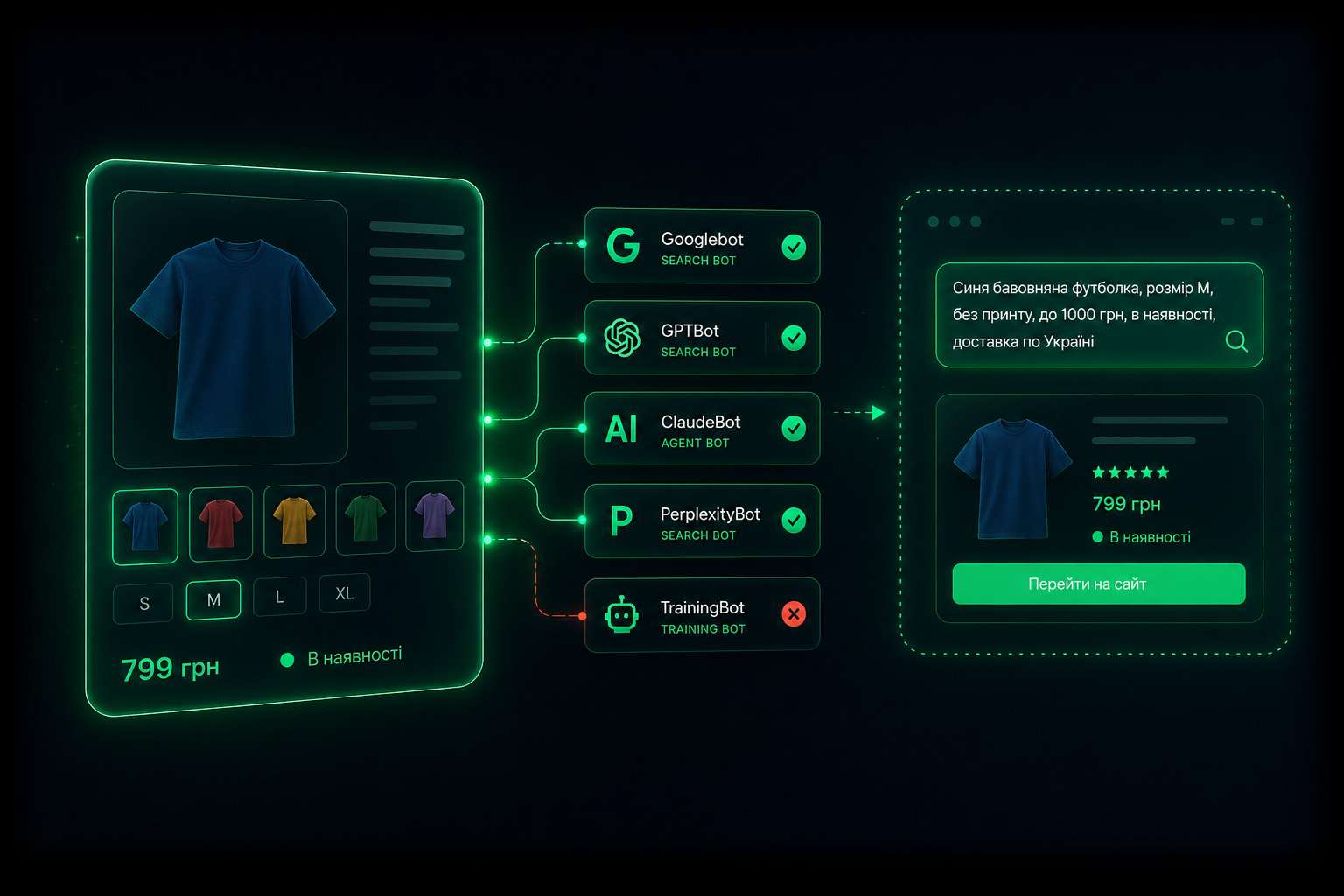
Just a few years ago, the customer journey was straightforward: open Google, type in a product name, visit a few websites, and manually compare prices. Today, a growing number of shoppers are starting their search differently. They describe their needs to ChatGPT, Gemini, Perplexity, or another AI service and expect to receive a ready-made, curated selection.
For example, instead of simply searching "buy t-shirt", a shopper might write:
Find a blue cotton t-shirt in size M, without a large print, under 1,000 UAH, currently in stock and available for delivery across Ukraine.
Artificial intelligence must instantly parse multiple parameters at once: product type, color, material, size, design, price, availability, and shipping options. Once processed, it compares options and directs the user straight to the matching product page.
For an online store owner, this represents an additional customer acquisition channel. Alongside Google, paid ads, marketplaces, social media, and email marketing, AI search is steadily taking shape.
However, AI cannot properly recommend a product if the store catalog is in disarray. Incomplete titles, wrong barcodes, outdated prices, missing specifications, and conflicting inventory counts make a product incomprehensible not just to AI, but to traditional search engines and ad platforms as well.
What Is AI Traffic?
AI traffic refers to visitors who arrive at an online store from artificial intelligence-driven platforms. These traffic sources include ChatGPT, Gemini, Perplexity, Copilot, and other AI systems that assist users in searching, comparing, and selecting products.
The difference lies in more than just the referral URL. Often, the user has already conducted a significant portion of their research directly within the AI tool. They have refined their request, defined their budget, selected specific attributes, and only then clicked through to the retailer’s website.
Because of this, such visitors are often much closer to making a purchase than someone who casually clicked a high-level, broad search query.
AI Referrals Can No Longer Be Considered Random Traffic
According to an Adobe Digital Insights report, in May 2026, the share of AI referrals to U.S. retail websites surged by 138% year-over-year. Adobe also noted that this was the highest figure recorded since tracking began in October 2024.
What matters isn't just the growing volume of these referrals, but also their quality. Digital Commerce 360, referencing March data from Adobe, reported that AI traffic converted 42% better than other sources. By Adobe's May report, that gap had expanded to 54%. This demonstrates how rapidly performance metrics can shift as AI search capabilities mature.
According to Adobe's May data, visitors coming from AI platforms demonstrated 15% higher engagement, viewed 23% more pages, spent 53% more time on site, and had a 36% lower bounce rate. Furthermore, revenue per visit (RPV) from AI referrals was 53% higher compared to standard traffic channels.
While these figures reflect the U.S. retail market and don't guarantee identical results for every store, they clearly indicate the overarching trend: AI search is already capable of delivering high-intent buyers, not just curious readers.
How AI Search Differs from Traditional Search
A traditional search query usually consists of just a few keywords:
blue t-shirt
t-shirt size M
buy cotton t-shirt
women's t-shirt no print
An online store optimizes its presence around these specific phrases by adjusting category titles, meta tags, product descriptions, headings, and internal linking.
Conversations with AI are typically far more detailed. A user might specify all of the following upfront:
product type
color
size
material
intended use
budget limit
desired delivery timeline
additional preferences
They can then refine the query dynamically:
Show only options without graphic prints.
Remove items over 800 UAH.
Keep only those that can be delivered this week.
Consequently, AI search doesn't just match keywords on a web page; it evaluates how well a product matches a complex matrix of user constraints.
AI Doesn't Read Catalogs the Way Humans Do
A human shopper can look at a product photo and infer that a t-shirt is blue. They can open a dropdown menu, click through sizes, and see that size M is in stock. They can also read text on an image banner and realize a discount applies.
For an automated system, things are more complex. If the color is only shown in an image, the size options are rendered dynamically via JavaScript, or the promotional discount is embedded directly into a graphic asset, crucial data can easily be missed.
That is why key product information must be delivered in structured, machine-readable formats:
in dedicated product data fields;
within attributes and options;
in the initial server-rendered HTML;
via JSON-LD structured data markup;
in product data feeds;
through stable URLs and unique product identifiers.
Think of a Product Card as a Questionnaire
To put it simply, imagine a standardized form or questionnaire.
If it only says:
Product Name: T-shirt
This information is far too vague. It offers no insight into color, material, size, pricing, or stock status.
A fully optimized product card looks more like this:
Title: Essential Blue Cotton T-Shirt
SKU: TS-BLUE-001
Color: Blue
Material: 100% Cotton
Size: M
Gender: Unisex
Price: 799 UAH
Availability: In Stock
Condition: New
Shipping: Across Ukraine
Returns: Standard store return policy applies
This level of structured data allows automated systems to understand your product unequivocally.
Data Quality Trumps Marketing Buzzwords
Phrases like "best price," "premium quality," or "the ultimate choice" might work in marketing copy, but they communicate virtually no factual information about a product.
To match items accurately, AI systems need specific, factual answers:
what the product actually is;
who it is intended for;
what materials or ingredients it contains;
what sizes or dimensions are available;
how it differs from alternative models;
what is included in the package;
how it should be used or maintained;
whether any usage restrictions apply;
when and how it can be delivered.
This doesn't mean product descriptions should turn into dry, robotic spec sheets. A high-converting product detail page balances two layers of information:
clear, structured attributes for technical parsing;
engaging, readable copy that helps humans make a confident buying decision.
Three Sources of Information for a Single Product
In an e-commerce store, product data typically exists across three main layers simultaneously.
1. The Visible Product Page
This is what human visitors see: title, images, price, size selector, stock indicator, product description, add-to-cart button, and delivery or return terms.
2. Structured Data
This is a JSON-LD code block that explicitly tells search engines and bots that the page represents an e-commerce product rather than a standard blog article. It transmits details such as name, price, currency, condition, availability, ratings, images, shipping policies, and return rules.
3. Product Data Feeds
This is a structured file or API stream used to sync catalog data with Google Merchant Center, ad platforms, marketplaces, affiliate networks, and AI services.
The cardinal rule here is simple: information across all three layers must match perfectly.
Why Data Discrepancies Create Problems
Consider this scenario:
on the product page, a t-shirt costs 799 UAH;
the JSON-LD schema lists it at 749 UAH;
the product feed reflects an old price of 699 UAH;
size M is shown as available on the website;
the feed marks size M as out of stock.
Search engines and advertising algorithms cannot determine which source is truthful. As a result, they may display incorrect pricing, disapprove product listings, throttle reach, or ignore the item altogether.
Google explicitly requires that stock availability in Merchant Center match what is shown on the product page, during checkout, and within structured schema data. The exact same rule applies to pricing and key product identifiers.
Why Product Schema Markup Matters
Google recommends passing e-commerce data using Product structured data markup. For transactional product pages, structured schema helps transmit price, availability, reviews, shipping details, return policies, and other commercial attributes.
Structured data does not replace visible content. You cannot specify properties in JSON-LD that are completely absent from the user-facing page. Schema markup is meant to clarify existing on-page content, not present an alternative version of it.
Google also highlights that using on-page structured data alongside a Merchant Center feed increases its systems' ability to cross-verify product information accurately. Certain enhanced rich results rely on data from both sources simultaneously.
How to Properly Display Colors and Sizes
Product variants remain one of the most common stumbling blocks for e-commerce stores.
A single t-shirt model might offer:
blue, white, and black colorways;
sizes S, M, L, and XL;
varying stock levels for each color-size combination;
dedicated photos for each color variant;
price variations depending on size or color.
To a customer, this is one t-shirt model with multiple options. In the store's backend database, however, it might be split into dozens of distinct SKUs.
Google recommends grouping related options using ProductGroup markup. Under a parent group, shared model attributes can be declared, while specific properties—such as color, size, image URL, price, stock, and individual URLs—are defined per variant. Key properties used for this include variesBy, hasVariant, and productGroupID.
In plain English, this means:
systems must clearly understand that all variants belong to the same product family;
each specific variant must carry its own accurate data;
switching between colors or sizes should not obscure updated pricing and availability;
parent product IDs must remain consistent and stable over time.
SKU, GTIN, EAN, and Model: Why So Many Codes?
Product identifiers allow different platforms and databases to recognize the exact item being sold.
SKU
A Stock Keeping Unit is an internal merchant code used for inventory management. Example:
TS-BLUE-M-001
GTIN or EAN
A Global Trade Item Number (or EAN in Europe) is a globally unique identifier usually assigned by the manufacturer. It enables precise product identification across marketplaces and global search networks.
Model Number or MPN
The Manufacturer Part Number identifies a specific product line or design from the maker.
OpenAI's product feed specification requires a stable, unique item_id for every variant, along with optional GTIN and MPN fields. OpenAI specifically emphasizes that product identifiers must remain consistent over time.
Never generate fake GTINs for items that lack them, avoid assigning the same barcode to multiple distinct items, and never reuse identifiers from similar products.
Price Must Be More Than Just a Number
For algorithms to interpret pricing correctly, they require:
a clean numeric value;
an ISO currency code;
the standard regular price;
the promotional/sale price (if active);
sale start and end dates;
unit pricing parameters (where applicable).
A raw number like "799" without a currency code is ambiguous. Prices must always be paired with currency designations, such as `UAH` or `USD`.
OpenAI's product catalog guidelines mandate listing the base price alongside a valid currency code, while providing separate fields for sale prices and promotional date ranges.
Stock Status Must Update Quickly
AI search might match a product perfectly to a user's prompt, but that recommendation becomes useless if the user clicks through only to find their size is out of stock.
Every variant must expose an accurate availability status:
in stock;
out of stock;
pre-order;
backorder;
status unknown.
OpenAI explicitly highlights real-time inventory precision as a prerequisite for displaying products that users can actually purchase. Their specification supports explicit statuses: in_stock, out_of_stock, pre_order, backorder, and unknown.
For store owners, this means stock updates must flow reliably across every operational channel:
the product detail page;
the shopping cart;
structured schema tags;
Google Merchant Center;
third-party marketplaces;
AI product feeds.
Images Are Also Part of Product Data
The primary product image should clearly display the item being sold. For a blue t-shirt, avoid using a crowded collage text banner, lifestyle graphics, or images where the actual item is barely visible.
An optimal image portfolio includes:
front view;
back view;
fabric texture close-up;
true-to-life color depiction;
model fit shot;
size guides included as supplementary images rather than replacing structured text size data.
OpenAI's feed schema includes parameters for primary images alongside secondary image arrays. It also supports links to video clips and 3D models, though these remain optional for most stores.
Shipping and Returns Influence Buyer Decisions
Users frequently filter searches using specific logistics criteria:
delivery to a specific country;
guaranteed delivery within the current week;
local curbside or store pickup options;
free shipping thresholds;
return eligibility;
extended return windows.
If return policies and shipping rates are buried in fine print on a standalone policy page, automated systems may fail to associate those terms with individual products.
Google allows merchants to embed shipping costs and return rules directly within structured product offer schema. Search engines use this data to display rich commercial badges directly within search listings.
ChatGPT Is Developing Dedicated Product Search
In March 2026, OpenAI launched an enhanced shopping experience within ChatGPT powered by the Agentic Commerce Protocol. Users can describe what they need using natural language, set budget parameters, browse relevant products, compare technical specs side by side, and click through to purchase from merchants.
According to OpenAI, this infrastructure aims to supply ChatGPT with richer, real-time product data. For merchants, this opens up direct catalog integration alongside organic search web crawling.
OpenAI's feed schema covers:
unique item identifiers;
title and description;
GTIN and MPN;
main and supporting media assets;
regular and promotional pricing;
inventory levels;
variant metadata;
regional pricing and store availability;
additional parameters required for product display.
Submitting a product feed does not guarantee that every item will be featured for every query. Systems evaluate product relevancy, data freshness, site authority, and contextual signals before making recommendations.
You Don't Need a Separate Catalog for Every Channel
Here is an inefficient workflow:
a manager updates a price on the website;
another employee manually edits a Google Shopping spreadsheet;
a third person updates marketplace listings;
an AI feed exports once a week;
inventory numbers fall out of sync everywhere.
A better architecture relies on a **Single Source of Truth** for product data.
The core CMS or an integrated PIM (Product Information Management) system stores master data, which automatically populates all outbound channels:
the web storefront;
JSON-LD microdata;
Google Merchant Center;
marketplace connectors;
ad platforms;
partner exports;
AI search feeds.
When prices, titles, images, or stock levels change, those updates propagate across all channels simultaneously.
Why the DoorDash and Shopify Integration Is a Prime Example
In July 2026, DoorDash announced a native sales channel integration for U.S. brick-and-mortar retailers on Shopify. Merchants can list local catalogs on DoorDash without manual data imports or duplicate catalog maintenance.
The core technical highlight of this integration is that master catalog data and inventory counts remain managed entirely inside Shopify, syncing to DoorDash automatically. Store owners avoid managing separate inventories across platforms.
This illustrates a broader shift in e-commerce: an online store's CMS is evolving from a standalone website builder into a central commerce engine managing product distribution across multi-channel ecosystems.
The Next Stage: Agentic Commerce
Today, AI mostly helps consumers research and compare items. The next evolutionary step is autonomous **AI agents** acting on behalf of users to execute complex tasks:
sourcing matching items;
evaluating total costs across stores;
verifying shipping speed and rules;
selecting precise color/size combinations;
initiating checkout workflows;
executing authorized payment transactions.
TechRadar refers to this trend as **agentic commerce**, noting that implementing it requires more than embedding a basic customer support chatbot. It demands secure payment and technical infrastructure capable of verifying buyer intent, agent permissions, transaction limits, and payment security protocols.
While this field is still evolving, it underlines why high-quality, structured product data is essential. AI agents cannot make guesswork decisions about whether a price is valid, if an item is in stock, or what shipping will cost.
What Shouldn't Be Handed Over to an AI Agent Unchecked
Automated purchasing introduces security considerations. E-commerce platforms must distinguish between casual catalog browsing and actions that alter orders or transfer funds.
Sensitive transactions require strict guardrails:
explicit end-user confirmation step;
granular access permissions;
strict transaction amount and currency verification;
time-bound authorization tokens;
auditable activity logging;
encrypted handling of tokens and payment details;
instant order cancellation mechanisms.
Future-ready AI commerce goes far beyond SEO and product descriptions—it touches access control, payment gateways, logging, return policies, and financial risk mitigation for automated actions.
How to Check If AI Is Already Bringing You Customers
Without proper analytics tracking, online store owners might miss incoming traffic from emerging AI channels, as AI referrals are often lumped into broad referral traffic categories.
In Google Analytics 4 (GA4) or custom tracking tools, set up dedicated traffic groupings for AI platforms, including:
ChatGPT
Gemini
Perplexity
Copilot
other emerging AI discovery platforms
Monitor key metrics for this channel segment:
session volume;
new vs. returning visitors;
product views per session;
add-to-cart rates;
checkout initiation rates;
completed orders;
e-commerce conversion rate;
total revenue generated;
average order value (AOV);
order cancellation rates;
product return rates.
Adobe reports that 50% of surveyed users click on links provided by AI during product research, and 27% complete purchases via those direct links. Store owners should validate these benchmark statistics against their own analytics data.
Page Crawlability and Accessibility
Supplying an AI feed does not eliminate the need for an optimized, crawlable web store. Product pages must:
return correct HTTP 200 status codes;
avoid redirection loops;
utilize clean, stable URLs;
include accurate self-referential canonical tags;
render vital content in the initial HTML response;
be fully optimized for mobile devices;
maintain fast server response and page load times;
avoid being blocked by overly restrictive security rules or firewalls.
Adobe highlighted that many retail websites remain poorly optimized for automated parsing despite the rapid growth of AI traffic. During the first quarter of 2026, Adobe recorded significant year-over-year increases in AI-driven referrals to retail websites in the U.S.
This doesn't mean opening your server to every web crawler. Merchants should differentiate between beneficial search and shopping agents, standard web crawlers, aggressive data scrapers, and suspicious automated traffic.
Do You Need to Write Separate Texts for AI?
In most cases, no.
Creating separate text descriptions for human shoppers, Google, ChatGPT, and third-party marketplaces is inefficient and quickly leads to data contradictions across platforms.
The better strategy is to establish a strong foundational content repository:
accurate, descriptive title;
concise introductory summary;
structured technical attributes;
detailed product narrative;
authentic product highlights without hyperbole;
clear usage limitations or care instructions;
sizing/buying guides;
transparent shipping and return conditions.
This core dataset can then be dynamically adapted to meet specific channel formats while maintaining total informational consistency.
Should You Urgently Invest in GEO?
GEO, or **Generative Engine Optimization**, refers to optimizing digital content for visibility within generative AI search engines and conversational response systems.
While specialized tools, visibility trackers, and optimization services are emerging around GEO, merchants shouldn't invest heavily in third-party GEO tools if their primary catalog still suffers from missing attributes, missing barcodes, or out-of-sync prices.
Focus on foundational essentials first:
clean up catalog attributes and product taxonomy;
verify search indexing and crawlability;
fix structured data JSON-LD issues;
synchronize automated product feeds;
configure advanced channel analytics;
publish helpful, authoritative content assets;
only then evaluate visibility metrics across specific AI tools.
These foundational improvements yield immediate value regardless of market trends. They simultaneously enhance technical SEO, Google Shopping performance, site search precision, marketplace integrations, and overall user experience.
Common Catalog Issues in OpenCart and PrestaShop
An e-commerce platform itself is rarely the root problem; performance depends on how the catalog architecture is implemented.
Stores running on OpenCart, PrestaShop, and similar platforms frequently encounter these recurring issues:
key attributes hardcoded inside HTML descriptions rather than stored in database fields;
colors mentioned in product titles but missing from dedicated attribute tables;
sizes stored as basic options that fail to map into outbound feeds;
EAN barcodes stored in custom modules that don't export cleanly;
a single SKU shared across different product variants;
product feeds updating on slow schedules compared to live site changes;
JSON-LD markup rendering outdated prices;
server caching displaying stale inventory counts;
multilingual store setups outputting broken canonical links;
color variants created as disconnected products without parent-child relationships;
essential product details rendered exclusively via post-load AJAX calls.
Resolving these issues rarely requires migrating your entire store to a new platform. Usually, it involves optimizing the data model, updating export plugins, refining product templates, auditing schema markup, and configuring real-time inventory synchronization.
Step-by-Step E-Commerce Audit Checklist
Step 1. Audit Product Titles
Ensure product names clearly state what the item is. Avoid keyword stuffing, but include essential identifying traits.
Step 2. Verify Product Identifiers
Scan for duplicate SKUs, missing EAN/GTIN codes, or broken model numbers. Assign accurate identifiers to every variant.
Step 3. Structure Attributes
Ensure color, size, material, capacity, and other specifications are stored in dedicated database fields rather than unformatted text blocks.
Step 4. Organize Product Families
Link color and size options logically under unified parent product relationships.
Step 5. Cross-Check Pricing
Reconcile prices across product pages, cart views, JSON-LD schema, Google Merchant Center, and outbound feeds.
Step 6. Verify Stock Synchronization
Confirm that stock status changes reflect immediately across all connected channels.
Step 7. Audit Product Media
Ensure primary images accurately depict the selected variant option.
Step 8. Test Structured Data Markup
Validate Product, Offer, and ProductGroup schemas to confirm they mirror visible page content.
Step 9. Audit Product Feeds
Check that feed files generate cleanly without errors, update automatically, and parse properly.
Step 10. Configure AI Channel Analytics
Isolate incoming traffic from ChatGPT and other AI sources to track conversions, revenue, and behavior metrics.
What NOT to Do
Don't append "for ChatGPT" to product titles.
Don't fabricate fake customer reviews or ratings.
Don't inject hidden data into JSON-LD schema that isn't visible to human shoppers on the page.
Don't manufacture fake GTIN numbers if genuine ones do not exist.
Don't push stale inventory data to external feeds.
Don't maintain separate, manually managed product databases for different channels.
Don't expect instant traffic surges immediately after publishing a feed file.
Don't neglect technical SEO, site speed, and general user experience.
What This Means for E-Commerce Store Owners
AI search is not replacing Google, paid search, or established marketplaces. It adds another high-intent channel through which modern shoppers discover and purchase products.
Stores best positioned to capture AI-driven market share are those with:
well-structured product attributes;
clean, unique identifiers;
properly linked variant groups;
real-time price and stock updates;
accurate, fully validated structured schema markup;
a unified single source of catalog data across all channels;
end-to-end performance and revenue tracking.
Preparing an online store for AI commerce isn't about installing a single magic plugin. It requires maintaining a clean product catalog, robust platform integrations, precise analytics, and solid technical SEO hygiene.
How SiteZilla Can Help
SiteZilla web studio provides technical e-commerce audits to evaluate your store catalog's readiness for search engines, ad networks, marketplaces, and AI discovery channels.
An audit evaluates:
product catalog taxonomy and database architecture;
SKU, EAN, GTIN, and MPN identifier integrity;
variant grouping (colors, sizes, configurations);
JSON-LD and Schema.org implementation;
Google Merchant Center catalog health;
real-time price and inventory feed sync accuracy;
multilingual configurations and canonical tags;
page crawlability, render performance, and bot access settings;
data update speeds across outbound integrations;
analytics tracking for traffic coming from ChatGPT and other AI platforms.
The output is an actionable engineering roadmap outlining exact data issues, their operational impact, and clear step-by-step resolution plans.
Frequently Asked Questions
Will AI search replace Google entirely?
Complete replacement is unlikely in the near future. AI is becoming an important additional method for discovering and evaluating products, while traditional search engines and SEO remain major traffic drivers.
Can a small online store attract AI traffic?
Yes. Store size is not a limiting factor. What matters is page accessibility, data clarity, accurate stock status, and how well product specifications match user queries.
Is installing a Schema.org plugin enough?
No. A schema plugin generates raw JSON-LD markup, but it cannot automatically fix inaccurate backend product attributes, duplicate barcode entries, or out-of-sync inventory counts.
Do I need a custom feed specifically for ChatGPT?
OpenAI maintains specific guidelines for product catalogs. However, feed data should ideally be generated from the same core database that powers your storefront and other channels.
Does submitting a feed guarantee my products will be featured?
No. Feeds ensure systems can parse and verify your product data accurately, but recommendation engines still weigh query relevance, item availability, and merchant signals before presenting products to users.
Do I need to rewrite all my product descriptions?
Not necessarily. Start by evaluating whether descriptions contain accurate factual information. Often, adding structured attribute fields, clear specs, and concise buyer answers is enough.
How do I know if AI traffic is generating revenue?
Segment AI platforms into a dedicated referral group within your analytics software and track metrics like cart additions, checkout steps, completed purchases, and revenue.
Should I open my site to all AI web crawlers?
No. Manage crawler access intentionally. Legitimate search and shopping bots should be permitted, while malicious data scrapers and aggressive bots should be filtered or blocked.
Conclusion
AI traffic is evolving from an experimental trickle into a reliable product discovery channel. Consumers are increasingly describing what they want in natural language, relying on AI tools to curate matching choices.
To compete effectively, an e-commerce store's catalog must be structured for seamless parsing by human buyers and machine algorithms alike.
Doing so requires:
clear, descriptive product titles;
structured product attributes;
accurate, unique product identifiers;
properly linked product variants;
real-time pricing and stock sync;
high-quality product imagery;
valid JSON-LD microdata;
synchronized multi-channel product feeds;
configured e-commerce tracking.
These enhancements don't just benefit platforms like ChatGPT. They simultaneously elevate performance across Google Shopping, organic SEO, internal site search, marketplace channels, and the overall customer experience.
Sources
Adobe Digital Insights — Q3 AI Traffic Trends Report.
Adobe — Research on AI traffic growth to retail websites.
Digital Commerce 360 — AI adoption scenarios in e-commerce (2026).
OpenAI — Powering Product Discovery in ChatGPT.
OpenAI Developers — Agentic Commerce Product Feed Specification.
Google Search Central — Product Structured Data documentation.
Google Search Central — ProductGroup and product variant schema guidelines.
Google Merchant Center — Product Data Specification.
TechRadar — Developments in agentic commerce and payment architecture requirements.
DoorDash — Native Shopify product catalog channel integration announcement.